Showing posts with label Identity. Show all posts

Saturday, 16 November 2013

Two points of view... They are both right!

In reflecting on the work we collaborated upon, which was an experience for the first time for many of the students, I was very keen to not take charge nor try to control the group's objectives, aims and working structure.   This would have been very easy for me to do, having been in management and in particular Project management roles for most of my working life.

I thought it best therefore for the students in our team to go through this collaborative learning excercise for themselves, whilst for me, to give them full encouraging support, but not to take over, nor run the project which I would naturally do.  Had I done so, I think the learning experience of the students would almost certainly have suffered, as it's possible, in fact highly probable, that the aims, objectives, formats and other project start-up criteria would have been formally established early (as would be usual, even in a small, but fully managed project of this type). It was very hard for me to keep very quiet and not automatically produce a work break-down structure, product and sub-product lists, bill of materials, task assessment plans, task & event timescales, milestone and go-no-go gates, even at a minimum, a gannt chart / task assessment etc.

Whilst it has been hard for me not take control,  I am glad that I was able to justifiably remove myself from (what I would consider as the mid-stage assement phase at prototype completion) during the last week (Week 3 from a total of 4). as I was simply uncontactable during that week's pre-booked vacation.

This meant that, in my opinion when I returned, the students have had a chance to of learned so much more by finding out the pitfalls for themselves, what worked, what doesn't / didn't work, who or what is reliable, who/ what is not, (i.e. group dynamics, general collaboration rules) and so on.

This may all sound a little patronising or 'smart' from me, but as I say, having been a project manager in many different sorts of business over the last 25 years, it was important (and even though it was hard for me to bite my tongue, see some failures looming and allow them to materialize), to let the team experience the reality of what it`s like to collaborate, see what would be needed to be done, (to individually take responsibility in a collaborative way etc), rather than simply providing them with a pre-defined formal operating framework and hence provide all the answers without learning from the experience.

So, from a more practical point of view, there have been many lessons learned by the group which as an observer in a sense,  I will suggest a few here to summarize conclude;

  1. Set the goals and aims of the project in a start up or kick off meeting,  when it is essential that all the stakeholders, which means the person (or persons) providing the breif; the people responsible for the design, production and technical capabilities, together with someone who can represent the end user (or customer, or viewer or reader etc. It doesn't need to be an actual customer or reader or user, but someone who is as well informed about that group at least). * This didnt really happen.  
  2. Agree all of the requirements and record any representations or special requests. Consider and agree collaboratively if they are achievable within the resources (cost, time, quality) constraints.
      Try to come out of that first meeting with as much agreement as possible, over the format, tasks needed, people responsibilities for what and when and so on.
  3.  Try and establish very basic risk management and contingencies. i.e. ask 'what if this or that, goes wrong / isnt done or whatever, to cover the immidiate possibilities.   
  4. A rough plan with timescales and milestones should be able to be created from all of this and it's important to make sure it is in writing as soon as possible and distributed to the whole team.

    All this might sound like overkill, but if you adopt these simple first steps, there is less likely-hood for things to go wrong later. It also means people know what is expected from them, and by when, and this stops (or at least reduces)  people from going off and doing their own thing.
  5. If necessary, appoint a suitable project manager (someone from the team who will document the above), and who'll be the central point of contact for control.
  6. if the project is big enough, write a project charter document!  What the aims are, how you will work together, when you will regularly meet at compulsory breifing meetings, how you will communicate, (i.e by what means). This should be the backbone document to further planning as it stops the team from loosing site of the goals and objectives.
  7. Make sure a prototype can be completed well in advance of production.  It is vital that when this is agreed, and the final prototype should be formally accepted by the whole group, (obviously, it can change, but again this must be managed in good time), then a total CHANGE FREEZE is put into place to stop any further development.  Production can then start properly, with less likelyhood of wastage, failure or late delivery.
Like I suggested earlier, these might seem like overkill steps, but should, in the very least, be considered. - You don`t have to implement every suggestion or step, but in reality, in a real project for production, especially in a commercial setting, or when arranging an exhibition (or any other event which is going to cost money) there can in fact be a whole lot more steps, depending on the aims, size and effects (or repercussion)  of the project, and this is often a full time job for a project manager.  

Anyway, I hope this post is useful for my peer students. I also really do hope that one massive lesson learned, (and it always is in a collaborative project), is that everyone has very unique skills, we all work differently to one another, its really fun and interesting to find out 'who' is suited to doing 'what' specific roles; where they excel and where they prefer not to do certain tasks.  It's always important to make sure people don't try to take on too much too, as whilst they mean well, and want to be heros, it can be extremely stressful for them at times and can even lead to fallings out, if timescale deadlines are missed and so on.

Co - labor -ation...  We are all (working) in it together and we must look after each other (share the load equally).

---------------

On a lighter note, I also found whilst doing some other research for the Contemporary Art in Context - theoretical  studies, this interesting snippet from around 2007 (I think, judging by Mr Paxman's hair colour and style, it was of this period).
It is a classical situation when two people have very specific beliefs (in reality, these could be almost anything, like football teams or favourite restaurants etc), and poopr Jeremy was trying to arbitrate between two contemporary artists.

Jeremy Paxman with two contemporary artists


Tuesday, 12 November 2013

Dialogue Project progress

Finished my sketches for the dialogue project today, and just working out the text to add to the images that will establish or provoke some kind of dialoge or questions or other actions from the reader.  I've thought hard about he types of sentences to use to 'hook' the reader or view into looking a little longer at the background images...  I have had a number of options that spring to mind, such as;


  • simple titles
  • some dream related text
  • some explanatory text of the image
  • some unconnected references that might make the reader question relationships
  • some kind of riddle buried in the text
  • and last (but not least as I know there are many other variants), perhaps I can combine some sort of (what appears to be non sensical if viewed superficially) plays with words...
So I need to choose some form of text from the options above... I need to be mindful that as the theme of the publication has been decided by the group to consider 'dreams' then the relevent choice ought to be connected to that.

My best option I believe will be to make some kind of playful statement, using word play that is both relevent to the image on a deeper level, and which will entertain the viewer to help them more likely to engage with the rest of the booklet.  So with this combination coupled with a sence of playfulness, I am considering using some of the wonderful quotes left to us from comedy.  As the audience is likely to be unlimited nor age restrficted, these quotes must be suitable for delicate sensibilities, yet provide conundrums, paradoxes or riddles that are appealing to a wide audience, both mature and young. 

In our Art in Context and theoretical studies,  we have also been spending a fair bit of focus on Carl Marx and the hypothesis he developed with Engels in 1850... So in playful acknowledgement of this, I have decided to use some quotes from Marx...  That is Groucho Marx And his brothers Harpo and Loui from the 1940s and 1950s comedy films... (I hope this is taken by the viewers in good light, it is not meant to mock the academic importance of our research, but just make a playful connection for the purpose of entertaining and thought provocation).

So my final 6 pieces, based on 5 text and image sketches and on of pure text is as follows;

Monday, 11 November 2013

Back in the saddle again after a week's vacation...

Back in to the swing of University life again today, after taking a pre-booked week out with my wife for her to have a really well deserved holiday.  (I also used the sojourn to take some study photos that I can add to my Project 1 Identities portfolio too).

The team that I am attached to have started some really creative work to include in our assignment for a text and image publication.  It's been agreed that there will be around 30 pages consisting of 5 drawings and one page of text from each of the five team members.  We still have some production to do and the deadline is moving ever nearer.  I'm a bit concerned that there will be a really heavy day on Friday this week to get two assignments completed and finished off.  However I'm really grateful for some skilled footwork by team member Daisy, during our evaluation of work so far by our course tutor, in her deft negotiation to get an extension over the weekend, ready for a proposed mini-exhibition on Monday.  (Nice one Daisy)!

So, whilst I think my illustrations relating to dreams are a useful addition to the publication, I'm also blown away by the creativity of some of the other work the team has done.  I'm keen to try some new but simple and elegant methods that they have come up with, not of course to plagiarise anything, but to add and adapt, which I am learning is a kind of post-modern mantra...

Tuesday, 29 October 2013

Inspiration sought from Brains Exhibition at MOSI

The opportunity to attend a display at Manchester's Museum of Science and Industry was intended to  provide our team with some inspiration, particularly around our theme chosen for the Dialogue project and Dreams.  The stimuli for this inspiration was a new exibition by MOSI on the brain. It was an exhibition created by both scientists and artists working together, and the resulting combination provided a worthwhile trip.  I was a little dissapointed that only two others from our team of five decided to show up at the agreed time outside university, for me to drive over and collect them, take them to Manchester and then return them back again. Nevertheless, the two students who accompanied me were clearly grateful and I hope inspired in some way by what they saw.

I am still working on what to prepare and present within the Dreams / Dialogue project as I have struggled to successfully remember the dreams I've experienced over the last few nights.  My task was to research the scientific theories around why we dream, and I have started to gather sufficient material for that to be evaluated by the team to chose what we include in our intended publication.

Meanwhile, my artistic output has been a little slow overt recent days as I have perhaps been thinking rather than doing a little too much. I must keep in mind the latin phrase that I found earlier, which tranlates to 'never a day without a line'

Friday, 25 October 2013

An open mind...

It's been a strange week.  I've been very anxious for the other students a little too much this week, and this has had a bearing on my own concentration and output.  Unfortunately, it's something I have to accept that sometime my empathy is a little too strong, I just automatically start worrying for others.  It's a habit that locks me down so often, which caused me to ruminate and hence loose time and some creative enthusiasm. It's a schema that I would benefit from changing.

Anyway, to summarize where I am... The contemporary practice in context (i.e. the theory part) seems to be raising a lot of concern and fears in the group this week, as to what needs to be done, and what is right, and what is wrong.  It has meant that there has developed a conversation and notion of rightness and wrongness, which when thought about deeply, doesn't actually exist.  What has been set for us to do, is really quite open and whilst there is guidance, there are no hard boundaries that might hold us in.  We are free to explore where-ever and whatever we want to.  The only output (or products) at this stage is for each of us to create a mind-map of a philosopher / theorist, or a favoured artist's or even an art movement's Manifesto.  Once this mind map has been created, we then should be able to create an image (in what-ever format we want, so it can be a drawing, painting, piece of sculpture, electronic representation or whatever), that captures some key identifying component(or components) of the chosen theorist or manifesto...

To repeat the phrase that I keep coming back to, which Shakespeare wrote in Hamlett act 2...
  "Nothing is either right nor wrong, but thinking makes it so"...

(I shall keep coming back to this wonderful phrase again and again, I am sure of it...:-) )...

This notion of "nothing is right or wrong but thinking makes it so" is really part of the essence of post-modernism I suppose.  Almost anything goes... This is reflected very much not just in our contemporary culture but also in our art too.

So, onto a more focused reflection my thinking...

Having decided to consider the artist Jean Tinguely, for my choice of theorist for study in Contemporary Art Practice in Context project, I've been gathering references to his material.

The choice of using Jean Tinguely as both a theorist, practitioner and artist (someone whom I had never come across before), has given me a greater challenge to gather research, simply because records of him and his work seem a little harder to obtain, if compared with a more generally known artist or celebrated movement...  I see this as a positive thing.  It has meant that I have to research in a much more focused way, but in so doing, has caused me to touch and review very many unconnected sources of inspiration and resources of study.

Tunguely, perhaps a lesser known artist within the UK but much more celebrated in Europe (especially in Switzerland, his birthplace), created the Manifesto "of Static" and from it grew the movement itself and corresponding manifesto;  he has probably become most famous for the creation of the theme and idea of "Meta-matics".


Wednesday, 23 October 2013

Project 2: Collaborative text & publication on the theme of "Dialogue"

We are now into week 5 of our degree studies; the first project on the theme of Identities is now beginning to crystallise into a proposal for a final piece.

Our next four week assignment will be to conduct an in-depth and disciplined approach to help us develop a collaborative product.  This will be a publication of some sort which explores the theme of dialogue in some way.

The brief given is that it must be cheap to produce, we should aim to create between 25 to 50 copies, more if successful.  (2 copies will be required for assessment and additional copies will be required for an end of term exhibition).  We have a free range on materials / media / size etc.  We were told to work in collaborative groups of 4 people, preferrably with two students who we didn't know and had not worked with before, so we quite quickly formed into a group of two males and two female students.

My initial instinct, (after many years of conditioning from being a Project Manager), was to think of an approach, just like any other project or task... That is, to create a plan.  My thoughts were almost automatic in Establishing an "OST"  (Objective(s),  Strategy, and Tactics....  Collaborative - delegation of duties, i.e. What needs doing, by whom and by when.  Creating a timeline of sub-products to bla bla bla.....
-  I immediately stopped myself from taking charge and putting my views forward, and I allowed  the group to evolve it's own ideas before committing any of my own rather regimented preconceptions.  This was a good thing to do, as it allowed for a better cohesiveness between the team members.

We adjourned to the relaxed atmosphere of the SU bar;  discussed potential topics for the publication (not), and then after generally chatting and getting to know one another briefly, coming up almost spontaneously that a good topic, which we had just been chatting about for a while, might be "DREAMS"...

We returned to the studio.  Three different exercises were presented by Bob, Jill and Christian, our degree tutors to help us with our dialogues project.  These exercises were all focused on achieving the act of dialogue.  Each provided a concept or vehicle to start a conversation, or to exchange images, or movements or an ongoing process of creative meaning, through sharing.  i.e. "A dialogue".

Wednesday, 16 October 2013

More new inspired directions to view....

Some interesting inspirations received today.  I had a good 1-1 meeting with one of my course tutors, and he suggested that I explored a couple of named artists who have worked on very intensive research for their own creations... Off to the library now to look them up!

Langland & Bell - See http://www.langlandsandbell.com/index.html

Essentially, these two artists create work that is taken from the observation that our personal relationships are intertwined with the architecture that we use, and mixes it with the coded systems of mass-communications and our personal transactions whilst navigating through our almost chaotic progress of technology within our globalised culture.

Their material is copyright, so the link will provide an reference point to their work.


Another contemporary representation ,beautifully rendered with the iconic symbol associated with London Underground is;


The Great Bear - Simon Paterson

See
http://shop.tate.org.uk/the-great-bear/invt/82


Ultimately, my objective is of trying to capture a symbol of Personal Identity.  The linkage of personal identity with 'the current' is also of importance.   I wish to portray a sense of 'being in the digital age'.

The other conscious factor I am keen to include is representation of one that is an aspect of our current culture. Within this sense there are a number of identifiers that I could choose from; I may have touched on some of these in my sketch and allegory of Fashionable Sheep in an earlier blog.  However I feel that that image is a little bit too antagonistic though, as it may just provoke some people, but not others...

I want a universal representation of personal identity that is cognizant to  everyone.

My thoughts are turning to what happens to all the accouterments of existence we surround ourselves with, once we are no longer living in this world.  The throw away society.  Nothing really matters to some.

This was brought home to me by an unfortunate recent incident, where I was asked via a computer generated request to provide an endorsement for an old colleague of mine.  Unfortunately, the person had died three years earlier.  Upon investigation, his records on the web-site that requested his endorsement where still open and active.  I looked at two other colleagues who I was connected to, who had also passed away within the last few years...  Their records too where fully available to me as though they were still alive and active.  We are constantly leaving information about ourselves in the digital ether, but it seems that nobody cares, "polices" or verifies it's validity.

Monday, 14 October 2013

Our Personal Identity & The State.

Identities of individuals (in effect, personal identities) were, (likely as not) first properly recorded by the Egyptians, and since then, a long line of rulers have found it necessary to identify as many of their subjects as possible throughout the ages, most of the time so that they could gather taxes from them.

The doomsday book commissioned by William the Conquerer was not the first of it's kind as a means of record for tax collection.  However, it was perhaps one of the first consolidated records of all the subjects, citizens and more importantly "the booty" that he had acquired of England.

Considering that our modern identity is perhaps, particularly only over the last 30 years, so reliant upon what the state, civil and social authorities, or global businesses hold in data bases for us, I considered an alternative way in which that mental image of identity could be reproduced.  In this case, I am thinking in terms of personal identifiers such as banking details, account numbers, finger-prints and other digitized mediums that almost all the populous has...


How could I use this in an a contemporary illustration of personal Identity began to emerge...


Sunday, 13 October 2013

Time to pause, check, evaluate and move on again

The past few days have been spent contemplating and researching the subject of identities via some alternative means, and what it means to me in particular.  I've been thinking about how to present an image as well as what an appropriate image could be.  I've considered and to some degree concluded, that the accessories that accompany an identity are not 'an identity in itself' and feel that such items are merely superfluous, in that, whilst such adornments are merely an extension of our desired persona, the true self is beyond the 'first appearance'.

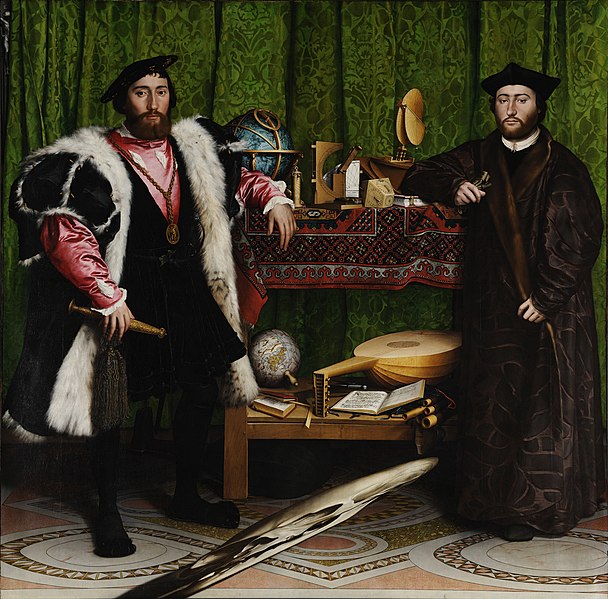
A good allegory to this is the Holbein painting of the Ambassadors, that I referred in an earlier post.  As one can see in the painting, which was completed in the time of Henry 8th, where the two very rich men of European nobility, are dressed in all their finery, together with their latest and greatest accouterments, to portray them with a sense of identity that reflects their highly valued nobility.

However, the "coded" image, which perhaps may not be understood to the viewer without explanation, which looks like a grey smudge at the bottom of the painting, is in fact a representation of a human skull.  It can only be seen properly by viewing the painting from a specific angle; by standing closely to the image, far to the low left of the painting and it is then revealed.  This may have been put in by Holbein as an allegory to both the subject's and our own human mortality.  Basically, in simple parleance, I think he was making the statement, "You may be rich, with all your fineness and ornaments of wealth, but you will still die like the rest of us and have nothing!"....  

(see Double Portrait of Jean de Dinteville and Georges de Selve ("The Ambassadors"), 1533. Oil and tempera on oak, National Gallery, London. )

Anyway, further pondering has, I'm glad to say given me a different view again...

What is identified in a Personal Identity?

Generally, the first  identity of a person is almost always thought of in terms of their facial features.  Here, I'm thinking of Passports, ID Cards, Warrant Cards, Driving Licences (modern) and the like.

However, we also have a deeper, inner identity which is not displayed.  By this, I mean our history, heritage, desires, goals, thoughts, attitudes, secrets, et cetera.  These are all subjects that could be used to illustrate personal identity.

Evaluate and move on... 


So to evaluate;  I have so far gathered some ideas, some good, some rejected and some to be shelved for the time being.  I have thought about the ephemeral and transient nature of identities, and introduced isolation as a theme.  I wanted to take a moment to jump slightly sideways in my thinking and consider other sources for ideas...

Amazingly, this was triggered after receiving a small present from a friend of mine, who had bought it whilst in Ethiopia.  The gift was wrapped before being brought back to the UK... Whilst I loved the gift inside, I was also struck by the wrapping paper and the designs printed on it.  The designs were clearly inspired by Chinese and Oriental images of people either in traditional dress or more current attire.  The fact that it was likely that the wrapping paper was probably even made in China, used as decoration in Ethiopia, and had arrived into my hands in the UK illustrated for me the international identities it had gathered along it's own journey to me.


This international theme got me thinking again about identities in a different context, - now I considered the permanence of identities again, and what better metaphor to combine permanence and national identity could there be on  a contemporary level than the carved images of the presidents on Mount Rushmore...

Quick reference / Pencil drawing in HB and 2B Graphite, with water for shading.
Maybe I could translate the grandeur of these famous personal identities to some other innovative representation?

Time for another mind map perhaps, but without any pre-conceived boundaries this time...

Recursive Loop Mind-Map of identity... - Without Man, there would be no identities...
I attempted to create a mind map with no boundaries!... Big mistake maybe, or maybe not.  Whilst the exercise was very fruitful in providing new possibilities to illustrate and hence add to this body of work, something struck me.  If I recall, it was Linnaeus (Carl Linnaeus (1707 – 1778) who attempted to catalogue every living thing on earth, no mean feet at all, but it took him a lifetime and he was still (by modern comparisons) only at the beginning, by the time the poor chap passed his mortal coil...  So rather than start something that can never be finished, I chose another branch of the mind map to pursue....  Our Personal Identity & The State.

Thursday, 10 October 2013

Identity, Isolation and Permenance...

Simple Conceptual drawing in HB pencil
The notion of using Dunstanburgh as a backdrop to illustrate the concept of identity and isolation, together with the expectation of the sea to wash away any temporarily rendered images of faces I intended to paint onto the large spherical boulders found there (I shall refer to these as beech boulders, to distinguish them from any other stones or pebbles of this region), provides a wonderful allegorical metaphor of the ephemeral nature of identity.  - Not just in terms of the short timescales of the tide washing away the identity of the faces through the sea regularly rising and falling twice every 24 hours, but also on the longer term view of identity, with the ever-present reminder of the ruins of Dunstanburgh behind the works, reminding us that over the last 1000 years the castle's original identity has been worn away stone by stone, either by human interference (i.e. removing the dressed ashlars and stones to build alternative structures or even other edifices with their own iconic identity, possibly, such as Lord Armstrong's rebuilding of Bamburgh Castle a short drive up the coast).  This concept, interestingly, was underlined by a lecture from Spencer Roberts which ostensibly discussed or place to view the universe, from the macro level to the micro level, - from the infinitely sub-atomic size to the infinitely huge scale of the universe and beyond.  Both are encapsulated in identity which is in constant play with time itself.

Close-up Conceptual drawing, 2B Graphite Pencil & Water
This sense of timescale and it's effects on identity is then brought into another context, of identity being a transient state, via the possible proposed work at Dunstanburgh, through the actual beech boulders' own physical identity, altering over the millennium through the erosion of friction by the gentle rubbing against each other and the effects of the wind, sea and rain.

This in itself is not dissimilar to our own encapsulated story of existence, that being completely transient, and our identity being 'weathered' and worn through our short lifetime on this earth.  This is an elegant image of our existence in relation to nature, time and space.

Wednesday, 9 October 2013

Looking at Isolation within a context of Identity...

My sheep and cows sketches got me thinking about the fact that as individuals, our identity is quite meaningless and lost when in a crowd of people.  I thought of an image I had started to sketch (and barely captured) some time ago, while stuck on a train during a long commute to London.  I was caught by the anonymity of the people, the fellow commuters, all standing in a silent row.  Their individual identity was unimportant, it was just a fleeting image of humans all burdened with the toils of labour, starting yet another day.  It was this collective identity that I wanted to hold on to.

Anonymous Intersections
[Quick Pencil Sketch inspired by Exploratory Drawing sessions]
I started to explore the concept of this ephemeral view of identity, and the thought of the isolation I felt whilst commuting in earlier times.

One of my passions is to find alternative places of isolation too, and I recalled the image of isolation that I find during my regular trips to Northumberland.  A favoured place is the beach near Embleton and the dramatic view of Dunstanborough Castle, an 'iconic' old ruin of an excellent example of early coastal fortress built during the conversion of the indiginous British population to Christianity through St Cuthbert and St Aiden.  It must have been buzzing at that time but is all but deserted (except for few tourists) in the present day.    This image appears many times in our psychy, and I even spotted it recently superimposed into a BBC children's TV show...
[Photo Image of Dunstanburgh Castle from Embleton Beech]
Simple HB Pencil - Illustrative / Concept Drawing
The thought of isolation together with the very roundly formed boulders found at the Castle end on this beach, lead me to speculate about a possible piece of work that could represent both the qualities of identity and isolation... At low tide, simply by painting a water based human face (with it's own identity) on some of these rocks, then allowing the tide to wash it away, would make a good allegory / metaphor for our own every day images of people that we see come and go, ebb and flo....


Tuesday, 8 October 2013

New ways of looking for inspiration


Another quote I recently stumbled upon, in a number of the research books is also a great affirmation for an Art Student...

                  Dies non transeat sine linea,     or,     nulla dies sine linea

Which roughly translates to

                                "never a day without a line...."

(Whereas the latin word 'linea' can mean both drawing and writing)

So...  I put my books away, watched and listened to an inspiring lecture from Professor Ryan Gander today, who uses many types of media to explore and create his work.  He is interested in the unseen things sometimes taken for granted in our every day lives.... the triggers and links through language that link to new thoughts for identities, IDs - pictures - drawings... you get the picture? (heh heh)

His works since 2003 have been prefixed with the title of Loose Associations"... so, as 2013 is his 10th year, this he calls LAX... Which happens to be the abbreiviation for Los Angeles International Airport in California.  and so another thread of associations develops...

It seems that a lot of Ryan's work has been influenced by the thinking of a 20th Century American sociologist / psychologist, Erving Goffman, and his books such as "The Backstage Language of Behaviour" published in 1959.  In fact, this book was cited in Ryan Ganders' lecture on 3rd October.

Further reading of some of Goffman's work helped me to explore the ideas and notions of identity in human behavior from an alternative perspective too, which Professor Gander also exploits to the full.  Goffman's work was inherently linked to human identity, another good reference would be "The Presenting of Self in Everyday Life".  A helicopter view of this provides a reference that his work emphasised the use of symbols in the performance of their social roles. i.e. Paraphrased very simply, this is "How people 'appear' to others."   Geoffman talks of a repertoire of symbols that actors develop to manage their social identities and to defend themselves from unwanted scrutiny or negative views and appraisals from others...  This sometimes leads them to act in a similar way to each other, hence establishing a common "stigma" or collective identity.

In this sense, I pursued my observations of groups of people together, which is most evident in larger assemblies of people, such as the environment I am in now... the university.  For fear of lots of controversy, I'm rather guarded about my next statement, however, I think it's very pertinent...

(Quick Water-colour Pencil Sketch)
Many people seem, particularly in a western culture, to be preoccupied with their self image.  They try to be unique for uniqueness sake... To be individual.  However, the symbols and signs used to create this seemingly individual identity generally all come from the same sources, based on whatever the current vogue or fashion might be...  This is sometimes described as the herding instinct, which I make (to me as obvious) link to herds of sheep, all trying to be different, yet ostensibly remain the same. With that in mind I made a number of thumbnail sketches of sheep wearing bling jewellery / baseball bats / driving new Range Rover Sports cars / Wearing Ralph Loren or Polo or Boss / having Tattoos and body piercings etc.   So it's almost like a rather limited vocabulary, just repeating the same symbols (or words) in a different way... A bit like the famous Eric Morcambe (TV Comedian of the 1970s & 80s) quote regarding Ernie Wise - his comedy partner's horrendous Piano playing; to a famous concert pianist (Andrte Previn)...  He said, "All the right notes are there, they are just coming out in the wrong order"... I feel that this is sometimes how it appears in our current culture.

[Sketch drawn in Manga Studio V4 - EX]
It is all basically (in my opinion) down to the fact that we are still just higher order primates! (I'm saying this, only slightly with tongue in cheek...:-) )

 We just want to belong to the group...  We want to belong to our tribe... - Just like 10s of thousands of years ago when we (as Homo Erectus, then as Homo Sapiens...) were moving from the jungles to the plains.

We as humans don't want to be left out. We need to be part of a group.  We get our primal needs of safety through this feeling of belonging to a group, but it seems very few people will accept that it is because of 'in-security'  - that may be one of the strongest motivators!...

So, as an experiment, just suppose, from an "Identity" point of view, what would a sheep or any other animal say about humans?

I wondered...

Project 1: Identity & Narrative. - Week 2 - Getting down to work.

Week 2 (w/c 30/09/2013)   Identity and Narrative.

Testing and playing with ideas about 'Identity' and how to create visual representations offered me a huge range of subjects to consider last week week.   I am beginning to move away from the set example of exploring this concept through super heroes though.

Exploring the theme again from scratch gave me the opportunity to re-set a personal mind map.  This will help me to identify and recognise a number of subset groups which again can be represented visually.

In psychology and sociology, identity is a person's conception and expression of their individuality or group affiliations. The concept is given a great deal of attention in social psychology and is also important in place identity.  We explored the relationship initially from a people centric view, but clearly, identity can be applied to any object, collection, city, plant, animal etc...

Meanwhile, with reference to my own journey of discovery,  after reading a quote from the book, Shock of the New, by Robert Hughes, (which was paraphrased from Tannhauser in 1860...)

      "Je Raisons de m'informer du pourquoi, et de transformer ma valupte en connaissance!"

      = I set out to discover the why of it, and transform my pleasure into knowledge!"

It seemed a fitting quote or affirmation, to help me in this journey to gain a better understanding of Contemporary Art in general...

.... Anyway, back to the plot!

To research the visualisation of identity, I thought that a simple review of the early 20th century artists would help to start some creativity.   So I make no apology for the brief free lesson in art history, over the last few hundred years....

I was initially caught by a simple statement that I found, - that prior to the Renaissance, almost all representations of people, objects and landscape scenes were "flat" and without perspective.  I simply hadn't realised this until now.  Recalling my limited memory of historically ancient images, such as cave paintings, Egyptian reliefs, and the religious iconography of the early progress of Christianity, it seemed an obvious observation, - all the images were indeed 'flat'.

However since the renaissance, almost all new paintings obeyed a wonderful new convention, that of having one point of perspective.  This was a geometrically new system, for depicting the illusion of reality. (Which is based on the notion of things that appear smaller, the further away from the eye it is).  This radical new convention was probably received with awe and amazement for the next few hundred years, however there was little challenge to this convention.  That is, until Paul Cezzanne started to question the concept that the "looker" affects the sight and that sight is affected by the memory of what the brain already knows, based on what has been seen before...

However, before I move away from the renaissance, perspective is a form of abstraction, and so it obeys it's own rules, to simplify the relationship between eye, brain and object.  This relies on a 'static' viewer or observer, and hence a stabilised or ideal field of view.  But this view is a separate single image of what light falls onto the retina of the eye, whearas the brain is free to indulge in separate contemplation....  An identity therefore, is merely a perception.

How we record the image in our mind, therefore constitutes an identity.


I was amazed that some of the most famous artists in history were able to capture an identity so immediately and so readily, and without the advent of photography, the ability to complete extremely quick paint sketches (i.e. contemporaneously) was vitally important for their craft.  We nowadays take for granted the camera and it's ability to freeze a moment in time that can be shared around the globe in an instant.


Since the establishment of the convention during the Renaissance, the method of capturing an image through the use of painting with perspective remained unchanged.  What the eye saw was translated through the artist's skill into as close to perfect a rendering of the subject before them, or in the case of a religious commission, the artist usually required models to pose for them with all the appropriate theatre and decoration.

During the 1800s, Artists continued to record generally what they saw.... We of course have the history of Constable and Turner as wonderful landscape painters, (plus too many others to name as portrait and landscape painters here).  At this time though, art was beginning to come into the reach of more ordinary people.


No longer did the heads of religious orders, nor extremely wealthy, nor the nobility have exclusive rights to own or commission new pieces of art.

With this slowly increasing availability of art, came a greater sense of commercialisation too.  Art was being compared.  Art was being valued (based on traditional institutionalised values of clarity, beauty, elegance, and of course skill). Art was being bought and sold, - particularly in the Paris Salons, which were the centres of congregation of the wealthy and 'trendy' from France and the rest of Europe.

These grand old institutions where all about conventions and rules and "how things should be".... This general stifling by the academias, salons and institutions of creativity must have been hard to deal with, especially during a time of huge social change, the industrial revolution, and the start of a cultural revolution (where Art, as that observer of such, was intrinsically intertwined. -  I wonder if I had lived during that time, I may have wanted to rebel?...  ).  The world was (especially in Europe) in a state of some turmoil, with regular national upheavals, wars and the Franco-Prussian war provides punctuation to that period.

These various factors may also be some of the reasons why the Impressionist movement of around the 1860s to 70s emerged. This group of artists wanted to record everything going on around them, all of what they witnessed in the new bright world, and in a new and colourful way.  Nevertheless, even the impressionists were continuing to create art, based generally on what they saw....  It was the representation of styles, colours and recording the images that was different and new.  (The title of the movement, "Impressionists" was not actually created by any member of it. It was in fact a label given to the artists, thrust on to them by an arty newspaper reporter & critic of 1874 who was negative and antagonistic to their work).

One of these newly inspired Impressionists, Paul Cezzanne, slightly outside on the fringes of the core Impressionist movement of Pissaro, Monet and Renoir, is generally recognised as the one who challenged the fundamental and stable conventions set in the time of the renaissance, (which was mainly that of perspective and painting a scene for the purpose of the viewer to gain recognition through copy and representation of the subject).  Cezzane changed his style to capture the viewer's actual participation in making perspective and perception of space through the critical use of colours and particular types of brush strokes to create the illusion of texture and shadows and hence space too as a viewer perceives the painting in itself.

What Cezzane did that was so radical, was to shift away from simply copying the images that he saw. At a time through the 1880s, Cezzane had experienced a number of personal blows, his father had died,  and having had only little success as an artist he became quite isolated working as a virtual recluse to his vocation, despite being significantly influenced by impressionists earlier in his career.

During this period of isolation though, he was able to develop and progress his own unique style.  He captured various studies of a scene that clearly he identified with, and inspired him during each of the passing seasons, and even at different times of the day.  The scene was of Mont Sainte-Victoire and his painting style was altered in order to portray the "mood" of an image, as well as the record of the image in itself.

Cezzanne was almost obsessed with this mountain it seems, as, over the course of the next 10 years or so, he painted it again and again.

This notion of looking at objects in a different way, that Cezzanne established, communicated and socialised with his peers, influenced further work through the later artists and the establishment of the Cubist Movement, Pablo Piccasso and George Braque.  These guys experimented in different ways of seeing, i.e. " to represent the fact that our knowledge of an object is made from all possible views of it; Top, sides, front and back."  They wanted to represent an image of their knowledge of an object by compressing it into one single view...


This, concept, surprisingly, was aided by "borrowing" an ancient and possibly primitive style of representation used in African Art, and in particular, the woodcarvings made, such as the Mahongwe Masks from the Gabon region.

Looking at the African mask in the lower section of this photograph shows the similarities quite clearly.

However, the new way of looking at things did not stop there... By breaking down images to the minimal construction of squares, triangles and circles, any image can be rendered.  Piccasso and the Cubist movement also explored this in a three dimensional recreation through the use of corresponding cubes & cylinders, cones and spheres...


  Piccaso's iconic paintings which virtually kick started the 20th Century took the way of looking at scenes to a whole new level!


I hope this provides a very condensed introduction to the 20th century emergence of why the traditional or classical conventions of art has been challenged by contemporary artists ever since.


The style of creating identities in very new and dynamic ways continues to this day.  The example of a preparatory study "study for narnia" by Euan Uglow in 1999 demonstrates how identity plays a massively important role in contemporary Art.


ROLL ON TO WEEK 3!!!