Showing posts with label Liminal. Show all posts

Sunday, 9 February 2014

An update to the Liminal Project

I spent an enjoyable rainy Sunday afternoon starting an acrylic painting of a piece of work that I'd sketched some time ago as part of the Liminal spaces project.    The majesty of the Huddersfield Railway Station is a classic symbol of status for this historic town, where much of it's original wealth had come from the woollen industry, and rather surprisingly, it's textile dye production...  I love the huge sweeping expanse in front of the staation, as well as the neo-classical architecture which makes a massive statement to anyone who visits or transfers through here.


The statue in front of the station is that of Harold Wilson, a Prime Minister of the United Kingdom, and whom I was extremely lucky to meet many years ago, after he had retired from office, but was stilll regularly engaged in public speaking.  I met him at our local Civic Hall during one such event.  His public image was that of a very powerful man (which usually suggests a larger physical stature), but when I met him, I was shocked at how short, and by that time, rather frail he was.

Monday, 16 December 2013

Reflections on this first semester

I have started to settle into a new routine of University study, assisted by the good practical tuition from my various tutors. The transition from 30 years working in industry into an academic environment have been smooth and easier than I had first anticipated.

Already, I feel my attitudes towards Contemporary Art in general, have changed significantly from my appreciation of it before starting this degree. I am able to more fluidly recognise the subtleties of contemporary art pieces, through my new & ongoing development of understanding semiotics, which, together with the assisted introduction to experimental drawing and exposure to artistic vocabulary such as simulacra and liminality; I can now begin to deconstruct various selected art pieces, to at least a rudimentary level of understanding, to equip me to provide a commentary of my basic interpretation.

My personal skills as a potential future artist are also beginning to form a foothold, (if not a foundation), through a more concentrated application of freeform drawing & painting. I have found the experimental drawing studies of particular benefit as these sessions not only exercise, but also stretch my draughtsmanship. The introduction to, and use of Adobe CS6 Indesign, Illustrator & Photoshop have also been essential and the tuition supported by the University’s access to Linda.com has proved very benificial.

My theoretical research has been following a path deeper into cultural philosophy than preconceived before attending the course, this area is of particular interest and stimulus to me too. I am learning to make contextual links to current and 19th / 20th century art in a more robust way. The exploration of representation by study of Immanuel Kant, Hegel and Bergson, together with research of Saussure & Pierce (for semiology / semiotics) and various other more recent philosophers has been very engaging.

Objectives for 2nd Semester.
I want to stretch my practical capabilities further by the use of alternative mediums and material, such as block print and clay, that are currently unfamiliar to me. I want to continue to immerse myself into more structured research of the links between contemporary culture, critical thinking and creative art;

My strategy will be to maintain and keep an open mind, but in particular for this next semester, I need to “play” more, engage with chance, and take more risks on my work, aimed at reducing my inhibiting adult schema barriers of expression and self-consciousness.


Reference Books read and used during this semester;
Ways of Seeing; by John Berger, Published 1972, by Penguin Books.*
Mithologies, by Roland Barthes, Published 1972, Rev. 2009, by Random House Group.*
Visible Signs, (An Introduction to Semiotics), by David Crow, Published 2003, by AVA Books.%
The Drawing Book, (A survey of the primary means of expression), By by Charles Darwent, Kate MacFarlane, Katharine Stout and Tania Kovats, Published 2007, by Black Dog Publishing.%
Spatialities the Geographies of Art and Architecture, by Judith Rugg, 2012 (Liminal Spaces), published by Intellect.%
Illustration, a Theoretical & Contextual Perspective, by Alan Male 2007, AVA Publishing*
100 Artists’ Manefestos, From the Futurists to the Stuckists, Selected by Alex Danchev, 2011, Penguin Classics*
Introducing Kant, a Graphic Guide, by Christopher Kul-Want & Andrej Klimowski 1996, Icon Books, London.*

Wednesday, 11 December 2013

Moving out of Liminal space, - Searching for the "queues and triggers"

 In continuance of the blog of Monday 9th, I took a little more time out to read an academic article following a University of Huddersfield library search, albeit for further rather maudlin consideration, namely "Stephen Palmer (2012) ‘Dead but not departed yet’: the exploration of liminal space in Jim Crace's Being Dead (1999), Mortality: Promoting the interdisciplinary study of death and dying, 17:1, 51-63, DOI: 10.1080/13576275.2012.651833.
This particular article backed up the research I had already found on Arnold Gannep and Victor Turner, with a critical view by Stephen Palmer of the novel "Being Dead", published in 1999 and written by the English writer Jim Crace.  The novel exploits the potential of literary narrative for exploring the liminal space between dying and death.
Whilst this theme seems to be of interest, I need to contemplate further to try and represent how the theme could be represented either visually or sensually.  My imagination is currently stuck in the visual image of the cemetery, particularly after my friends funeral and internment.  I chose to take some randomized views of a cemetery (not related to my friends!) for further stimulus.

Maybe I could work with these images to create something new?

I thought that the somber influences of death and graveyards must give way to a brighter future.  This liminal change, this threshold adaptation could be represented.  I am working on a diptych of two scenes of mortality and what comes from it, i.e. the trigger or queue for a new dawn or new season of hope.

Monday, 9 December 2013

Reflection on the week of Liminal Thoughts

It has been a rather "strained" and strange, week for me unfortunately.

I had to attend the funeral of a close old friend of mine on Wednesday.   I was asked by his son, somewhat unexpectedly that morning, to be a poll bearer for him, both for his funeral service at a local church, and again, at his internment.  This of course, I considered as an honour for me, and I readily agreed.  My friend David had been a driving and inpirational force for me through my twenties and early thirties.  Much of my values and beliefs of fairness and right and wrong were influenced at that time, and he truly was a guiding light.  Lowering his coffin into a deep hole on the side of a hill cemetary seemed to me to be undignified in a way, and I have dwelled on the image pressed on my mind.  Such finality.

Later this week, we also heard of the death of Nelson Mandella.  Strangely, news of this second death has really affected me emotionally too. I was already in a liminal space you could say, after literally laying my friend David to rest.  Nelson Mandella too was extremely inspirational.  His simple but unwavering determination for proper and recognised equality, regardless of colour, creed, religion or anything else, has been truly amazing.  This strength of character in the belief of right and wrong.
 In my own past, I have found great strength in the poem that I understand, was Mr Mandella's only source of courage during the many years of imprisonment on Robin Island, this being the poem "Invictus" by William Ernest Henley (1849–1903).

But the vulnerability of loosing respected others has taken it's toll on my own motivation, and I have found it hard to escape what I can now genuinely call a liminal state!

I am in a no-man's land.  I am in a zone of in-between-ness, but in my own case, there is nobody conducting the order of service, or right of passage, that I have mentioned before, is the additional essential ingredient for Liminality, according to Van Gannep.

.... Or is that Master of Ceremonies me?

I think it must be.

..... But I seem to be unable to move forward and have been rather lost for the last few sad days. I feel I am waiting for some sort of queue or prompt, just as an MC would, in order for me to move on....

Tuesday, 3 December 2013

Liminal Spaces, continued...

A weekly breifing from Christian helped me to re-evaluate my approach to the the Liminal Project.  I have been feeling that I was thinking a little too much about the synaptic gap, and the papier mache model that I have been working upon.
So, it would be worth my while to pusue some other threads this week, and not get too bogged down on just one piece of work.  I can always come back to it, once the various ideas have started to crystalise, so I made the decision to explore a little wider.  To perhaps move away from the literal meaning of Liminal, as taken from the origins of the word in an anthropological context, and explore conceptual contexts instead.

A suggested course of exploration would be (to paraphrase Christian),

"First, loose yourself, by taking any direction (metaphorically) and then put yourself into a place that you recognise,  in order to find yourself again".

I continued to look at the suggested Tate Gallery shots, for David Shrigley, Rachel Whiteread, David Blake, Paul Noble and Ed Ruscha.  All these artists work (or worked), in the liminal.  This included subjects such as Play, The Physical, Spiritual, Thoughts, and even car parks!

Coincidentally, I have also noticed that David Shrigley has just published a rather interesting book....;

I then got further inspiration from a one to one meeting with Christian, later in the day.  He recognised that my Synapse model was providing further metaphor for gaps and transfers, but I also have reflected since our conversation and I felt that he recognised my underlying desire to generally communicate; to provide knowledge transfers, as the backbone to my work.  If this was in fact what Christian was thinking, then I had (maybe unknowingly at the time) succeeded in the subliminal message I was trying to convey.

I was guided to look at a few more contemporary artists that might fit well with the genre I have been working within.  Namely, Martin Smith, "Laikaland";  Jim Bond,  and Bruce Lacey.

There is also a further opportunity that Jo Blaker suggested to me, to look at the work of Dominic Wilcox, and RCA Designer, who will be exhibiting at the "Creative Calderdale" exhibition in January.  Jo also gave me another "Bulb ON" moment (i.e. somewhat epiphinal), by recommending that I could explore more through...

                                     PLAY....
                                                            ....CHANCE....
                                                                                        ..... And take more RISKS!!!

Yep, that seems to sum me up quite well as to what I need to do.

Jo suggested a number of books that could be of use, and I enclude them here for my own future reference...  Chance, by Margaret Iverson;  "You'll Never Know"  (Drawing and Random Interference) by Krokatsis, (Hudd Uni Library reference 702.8 KRO;  and finally "Drawing on the Right Side of the Brain" by Betty Edwards (1982) Ref 741.2EDW.


Saturday, 30 November 2013

The Ultimate Liminal spaces in the brain...

Some of the thoughts around creating a symbolic representational sculpture of a brain synapse led me to explore in much further detail, the real research currently available.

Complete neuron cell diagram en
Image by by LadyofHats [Public domain], via Wikimedia Commons


The components of the brain I hadn't quite got correct, as I would need to firstly represent not just the neurone cells of the Synapse, but possibly more importantly, the Axion.

Image from http://www.enchantedlearning.com
/subjects/anatomy/brain/Neuron.shtml

This is the vital channel that links the cells together, and which (when they carry an excited electrical signal) provide the energisation of the synapse itself. (The Axion, is in effect, the synaptic nerve that makes links with each neurone).   So my mental image of representing the synaptic gap needed to be slightly adjusted.

Image from http://happypeopleteamblog.ru/
wp-content/uploads/2013/07/01_neurons_lg.jpg


The prototype sculpture I have started to form from a simple papier mache form, requires some adaptation.


 Currently, the representation of the synapse surface seems comparatively large and only illustrates the area of the synaptic gap itself.  I think it would be useful to make a more stretched Axion, maybe even putting a few Axions and neurone together to form a more life like representation?  A sketch shows the thoughts I have been developing.

Thursday, 28 November 2013

Physical representations of liminal spaces - "Replugged"

Taking the photo's of liminal spaces I researched last week, I tried to explore a subset of my current thinking threads (by temporarily moving off the neurone and synapse idea).  As an alternative thread I decided to explore reducing the photo views of liminal spaces to minimalist drawings... I think this area can be further explored particularly well by limiting the colours of drawings to just black and white, for example. The juxtaposition of black lines of the marks made against the white background of the paper, I felt could be "tested".  Arguably, a pencil drawing can be interpreted as liminal to some degree, as there is an innate capacity to render many differing shades of light grey through to dark black.  There is liminality in the marks of a pencil, but when using an ink pen however, there is ONLY a binary transition, i.e. there is no greyness, or threshold as such, the colours are only black or white, there is no in between-ness in the drawing process itself... (May be I'm on tangent boulevard with my thoughts about this? - Or is that in itself, a liminal space too perhaps... heh heh heh).

So this is how I got on....


 Ian M. suggested that some further exploration of this could be made by stripping out even more detail, and allowing myself to play more with the representation.


 How much do we need to delineate in order for an image to be recognisable as a form?


Monday, 25 November 2013

Mid stage assessment of Liminality

I've continued developing my ideas about using the synapse of a brain neurone as a possible target for a final work piece over the last few days.  My curiosity has been suitably triggered to challenge how I could represent it in a 3D model.  Currently, I'm of the opinion that in order to show liminality, I feel that each of the four attributes outlined by Gennep's definition, must be satisfied.  Therefore, if we are to apply this into an artistic concept (as opposed to an anthropological paradigm, from whence the application and usage of the word derives), then I can validate it through a neurone signal working it's way across the synapse as follows;

  1. Pre-liminal - The brain impulse travels in electrical form along the input to the neurone or cell.
  2. Liminal, the electrical impulse reaches the edge of the synaptic bridge. at this point, the cells of the synapse convert the electrical impulse into a chemical response, which it ejects into the synaptic gap.  Within this so called gap, there is a number of other "chemical solutions" as amino acids, hormones and proteins, peculiar to the brain in particular.  The most portentious combinations or solutions are more commonly known as hormones, and include, amongst others, Noradrenaline,  Serotonin and dopamine.  It is this synaptic gap that I consider as the ultimate liminal space.  The specific chemical response produced by the "transmitter" side of the synapse is dependent on a number of factors, which I would assume includes the strength of the electrical signal reaching the nerve ending. The resulting conversion to a chemical messenger suggests that there is liminality within the synaptic gap; The electrical impulse has been stripped away.  Unless the corresponding wall of the neurone to which the chemical message is intended (the receiver, or more correctly, the receptor) for is "set" to receive it, then the strength of the transfer will alter.  Not only is the transference affected by the state of the receptors being set in readiness, but they are also set to receive only certain types of the hormones described earlier.  The speed at which those chemical messengers are then re-absorbed back into the pool of the transmitter will also effect the vigour of the brain cell firing.  The way these chemical messengers affects the qualities of the brain impulse seem to relate to Dopamine being a "motivator" or an "Exciter", Serotonin being a "feel-good" or "happy" element, and Noradrenalyne seems to be related to the management of moods too. 
  3. So, once the impulse has reached the other side of the synapse and continues it's journey, the post liminal state has been satisfied.
  4. The "conductor" or MC for the synaptic event is the person to whom the neurone, and brain belong.
Therefore, all four of Genneps criteria have been satisfied.  Voila!... The perfect liminal space.

Friday, 22 November 2013

Some further research into the meaning of Liminality

Having spent some time reflecting on the spaces chosen to represent liminal exploration, from the micro level to the macro level, I wanted to probe  further into the real meaning of liminality, the liminal and the roots of the word's usage.

Initial research shows that it was originally used in an anthropological context, to signify a particular period during some form of cultural, or social, or status transformation as it a right of passage.  The first person to use the word in an academic sense appears to be attributed to the anthropologist Arnold van Gennep, in an article published around 1909.

(Reference; Les rites de passage (The Rites of Passage), A.van Geneep, 1909).

In Gennep's book, "Les Rites de Passage", he outlined a regular, and what appears to be, a reoccurring process, that can be considered in many if not most traditional "human" rites of passage, such as University Graduation, of coming of age, marriage ceremonies, and so on.  This schema does not only appear to apply to western cultures, it also appears in many others, for example; African maturity rites of passage ceremonies, Ndembu tribal coronation (Crowning of a new King), ceremonies,
(Reference; http://en.wikipedia.org/wiki/Victor_Turner).


  1. Pre-liminal.  Removal of the 'candidate' from their normal or daily environment / separation
  2. liminal period.  A state where not much happens at all, where previous accutriments are often stripped, an in-betweeness, like a kind of power-less / status-less, almost state-less "limbo", literally, "the threashold", before which is where the transition or transformation starts.
  3. Post-Liminal; This phase can be described as the transition, rebirth, regeneration, transformation or reassimilation of the "candidate" either into the environment from which they came, but with an altered status, or into a new (to them) environment all together.
  4. The one constant theme that also seems to appear is that there must be some sort of universal controller of the process, like a master of ceremonies or conductor of some sort.( Reference XX)
(According to Belmont, Nicole. - Arnold van Gennep: The Creator of French Ethnography Derek Coltman trans. Chicago: University of Chicago Press, 1979).

- (Arnold van Gennep, was an early 20th century, German/French, mostly self educated Anthropology Ethnographer and philosopher. He never held an accademic post as such, but continued his research and quest for learning for most of his life.  His work was later built upon by Anthropologist Victor Turner in the late 20th Century, which is cited above).

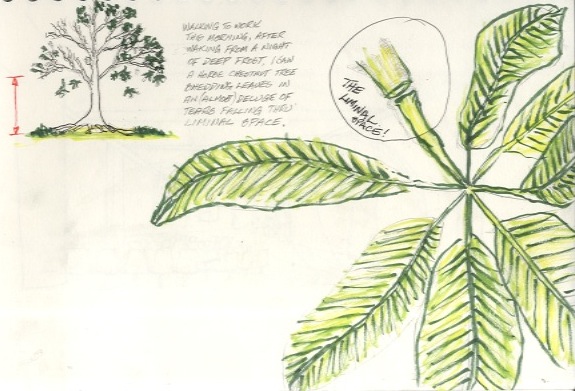
Considering the concept of the join between the leaf of a tree and the branch and twig to which it is joined, I studied a Horse Chestnut leaf that I had collected a few days before.  The leaf of a horse chestnut tree is described as a palmate leaf, which consists of 5 sub-leaves arranged from a central stalk.  There is a minute cleft between the points where the tree's fabric of wood stops and the green shoot or stem of the leaf starts. It is at this point, through osmosis, that water and nutrients pass from the roots of the tree to nourish the leaf growth during the spring and summer.  In return, the leaf produces the complex sugars or starch to sustain the wood of the tree through it's own growth.  So a transference takes place at this point. It is "managed" by nature itself, so that can be the reference to a controller or master of ceremonies, as per the definition of liminality from Arnold Van Gennep.  So this junction is a true liminal space!

Wednesday, 20 November 2013

Experimental drawing with Liminal Space

As a reflection on the experimental drawing session today, we had a great tutorial which took place in the university gymnasium. Powerful lamp projectors were used in the darkened hall to create liminary space through projected light. 

I tried to make referencial links to Proff. Victor Turner, regarding his own defiunitions of the liminal from his anthropological studies. It was possible to achieve this as there were three parts to thhe whole liminal process in the temporal sequence; that being the pre-liminal, liminal and post-liminal.  These can also be applied to the borders of transitions with movement between light and dark, forest to city, head to mind etc. 

Earlier it had been suggested to find links in work by Joale Kasinski, which provide an exploration from the seen to the unseen. - Pictures of motion, but then frozen or made static can have tthe same affect. (See Frederick Frank's book, "the Zen of Seeing"). - Trying to capture a sense of a pathway to another place or even to another dimension....

Graphite stick & Charcoal, with erased lines
We used inflated gymnasium exercise balls placed in the beams of the projectors to create interesting effects, for example, the lettering of the projector's manufacturer being distorted against a divergent surface, gave a subtle surrealist view...

Tuesday, 19 November 2013

Project 3 Liminal Spaces

Monday 18th November 2013.  The start of week 8, - marks the beginning of our 3rd and final project for this particular 12 week semester, prior to the Christmas break.  Over the next four weeks we will be creating a body of work that focuses upon the concept of the 'Liminal'... The Latin translation being the 'Threshold'...


I spent a little time savoring the spaces blocked off to general access of pedestrians, especially where building work is being carried out around the campus.  I considered this to fit the criteria for Liminal Spaces.
New Extension being built to the University


----------------
Researching others work; 
There are a number of current contemporary artists who are referencing liminal spaces in their work.  One artist who was part of the YBA (Young British Artists - A group originally of students who were supported by Charles Sattchi the advertising mogul, during the lat 1990s, who included Tracey Emins and Damien Hirst, amongst others), has recently been brought to my attention is Rachel Whiteread CBE (Born 1963). Rachel uses a variety of materials such as the discarded items often disposed of in day to day living  ( -This raises the value of the disposed items into a completely new dimension, as part of her art in itself).  I chose to look further at Rachel's work through her listing on the Tate website;  Reference; http://www.tate.org.uk/art/artists/rachel-whiteread-2319
Rachel Whiteread, Untitled (Stairs), 2001
Rachel Whiteread, Bookshelves, 1997


-------------

On my journey to work at the University the following day, I was walking through a wooded lane when a rather epiphanal moment struck me.

There had been a heavy frost the evening before, and a horse chestnut tree was just beginning to thaw from it's nightly slumber.  The tree was in the process of shedding it's leaves from the summer growth and this process has been accelerated by the ice forming at the synapse to each leaf.  Clumps of the palmate leaves were actually falling everywhere, in what I could almost describe as a deluge.  I imagined the falling leaves like the tears of grief from the tree, after the loss of the summer sun.  ...Winter was with us again.

I chose to spend time later that morning in the studio drawing trees loosing their leaves, the action caught me as a good example of a way to capture the liminal space between the branch twig-lets and the mounds of leaves on the earth.   Tracing the concept of where the true liminal space existed, but now on a micro level, I considered the leaf being adjoined to the shoot or twig and what the mechanism was that held it together.


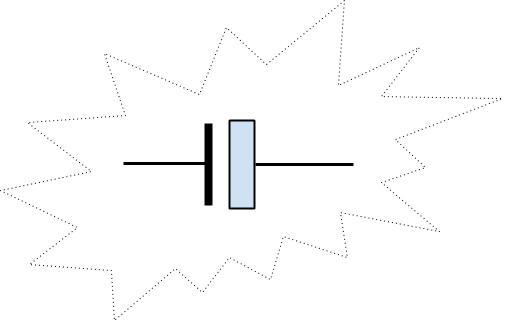
The junction and threshold concept can be taken further in an electrical (electronic) sense too.  The electronic component that comes to mind here is the capacitor.  (I learned about this passive little component some 35 years ago, whilst undertaking a Certificate of Secondary Education in Electronics).  This is essentially, two metal plates, face to face separated by a gap, that can be an air gap, or an insulator such as paper, a ceramic material or other sandwich of materials. In fact, what is called an electrolytic capacitor in particular, can be used as an allegory for a liminal space, particularly for electrons.  I choose an electrolytic capacitor in particular as these devices are usually polarised (which means electrons will only behave as anticipated if they are allowed to flow in a specific direction as designed. Reversing the polarity of an electrolytic capacitor can cause it to short-circuit or malfunction). Capacitors exhibit a property of temporarily storing an electrical charge, the larger surface area of the plate and type and surface area of the electrolyte determines how much.  The space in between the separated plates together with the electrolyte form a liminal space to electrons.   The fact that the electrons are stored up on one side (i.e. in one plate) of the capacitor, then rush across the other side through the liminal space (which then becomes empty again), serves as a great example of the concept we are studying.

The symbol of an electrolytic capacitor is to two parallel lines, separated with space, with one opposing conductor emanating from the centre of each line at the perpendicular... An Electrolytic capacitor is distinguished by on of the plates being boxed. Thus...

International Standards Organisation (ISO) Symbol of an Electrolytic Capacitor
Thinking further about the synapse, in it's more usual setting, - for describing the junctions of the brain neurons, I realized that the human brain synapse is the ultimate liminal space.  Transitions across them are both electrical and chemical, and the very activity in a collection of synapses is the threshold to our whole imagination, understanding, views, beliefs and all human thought.  Without those liminal transitions within the synapses, there would be no sense of liminality nor capability to visualise nor represent the same.

Later rumination on the subject of liminal spaces led me to think of how I used to spend a great deal of time commuting long distances in my past roles.  I have already captured a contemporary view of the commuters waiting in a station, and my imagination turned to the new commute I take each day via local public transport.  I was particularly thinking about the bus station as a liminal, transitional space, particularly the threshold between walking and being carried by a bus...