Showing posts with label Deconstructing_the_GM. Show all posts

Monday, 24 February 2014

Deconstructing the Grand Master - BWL - Part XIII Benjamin Williams Leader

So, after quite a bit of tweaking, I managed to get the video to about 3 minutes.  It is suitably brief, and I think, suitably confounding, yet also explanatory...
The video can also be accessed via You-Tube on the link below;
 http://youtu.be/Fzw-bgMVW9w

Friday, 21 February 2014

Deconstructing the Grand Master Part XII - Benjamin Williams Leader

I was able to reflect today on some of the suggestions made during this week by Dr Ian M. and Christian, my year tutor. IM suggested exploring the works of John Stezeker, whom I found to be of immediate help in looking through the theme of photographic montage, the combination of the old and the new, to find a "new" truth.  This can be seen particularly well in the series of "Old Masks" and "Fold"...

 In Stezakers "The Visitation"(2006) he is placing the old into the new, in a way that makes the image carry huge emotional power, by using a portrait of the Virgin Mary superimposed onto a man appearing to be sat at a table waiting for food perhaps, whilst reading a news paper.  I like the fact that the older picture is the religious icon, whilst the newer background frame, being black and white, suggests a more distant image from say the 1940s or 1950s, of an anaonymous male, white collar working class perhaps?  I believe the juxtaposition of image to context is what makes this work so well.
 The "Old Mask" series by John Stezaker explores potential memories, potentially in the images within the minds of the background subjects, replacing the facial features of the subject in such a way to almost obliterate their identity. However, their identity is in fact formed by these memory images themselves.  Ergo, they are still recognisable as individual identities through these combined images.  The memory is so often captured in our contemporary culture as a photographic image, which can then be shared with other viewers who may have had no immersion into the original domain that the photo inhabits.  This is particularly interesting as I see around us an slow shift of media from black & white photo images, to colour photo, and now through current technology, full colour film and sound clips uploaded to the internet that can be viewed by anyone, at any time, anywhere in the world.  Our memories are no longer kept as items within "local" repositories to share.... They are ubiquitous.

The images were similar to the final image of Autumn in Switzerland that I had created which has a background contemporary view of the landscape outside of the frame that Benjamin Williams Leader recorded.

I'm pleased that I was able to find current successful artists who have adopted a similar idea.


Tuesday, 18 February 2014

Deconstructing the Grand Master, Benjamin Williams Leader - Part XI - The Movie!

So, after lots of deep analysis, belly button gazing, twiddling of thumbs whilst looking at a blank screen, here if my first attempt at rendering a video montage of the work I have been doing over the past 6 weeks.  This is very much a synopsis at this stage, which lasts about 4 minutes 15 seconds... I think that is a little too long to keep people engaged positively, so I shall try to reduce some of the screen shots to get it to say 3 to 3.5 minutes overall.

So, here it is!


I still think that I can make a number of changes to this, - definitely a work in progress.  In reflection to some of the advice received from Dr I.M. yesterday, I am also keen to research some of the semiotics / meanings buried within the images of Leader's paintings; not only of the works "Autumn in Switzerland", but also many of his other works too.  The references to the sublime, the great out doors and nature, clean living and so on have been picked out, (and a little parodied by me in parts), however there is a greater force at work (ha ha), in most of the works of this era.  especially the Pre-Raphaelites influence on Leader at this time too, must have had an effect on his chosen subjects.


Saturday, 15 February 2014

Deconstructing the Grand Master Part X... Just a quick walk down Tangent Boulevard.....

One of the key things that keeps me motivated is to have a laugh, especially if it it just innocent fun.  I try hard not to upset anyone, but if I ever do, then I humbly apologise in every case.  To hurt, irritate or annoy someone with my (sometimes a little asinine) humour, is never my intention.

So, I feel better after making that "Safe Haven" statement above, which gives me a little artistic licence to try to de-construct that great luminary of contemporary philosophy, and the master of Deconstruction himself, the one and only Jaques Derrida.

And here it is....

Jaques Derrida
+ 
Graham Depainter


Did it make you laugh?... I hope so...

 But I actually think this is valid as a deconstruction, both in terms of text, and to some degree, the great Monsieur D. himself.  I got the impression he liked some humour.  It both satisfies some "differance" and "Undecidables" and binary oppositions with some common ground...  (All replies will be read!)... 

If not, try this...  A deconstruction by text, of a Great Master, a Royal Artist of the court to the King Phillip IV of Spain, one Diego Rodriguez de Silva Velazquez, (1599 to 1660), One of the greatest masters of the Golden Age of Spain and the Renaissance... 

Diego Velazquez circa 1635 - St Anthony the Abbot together with St Paul the Hermit
(Caption;)   "Ere Tony, ...I could murder a big mac......   Oo er"


Friday, 14 February 2014

Deconstructing the Grand Master Part IX - Benjamin Williams-Leader

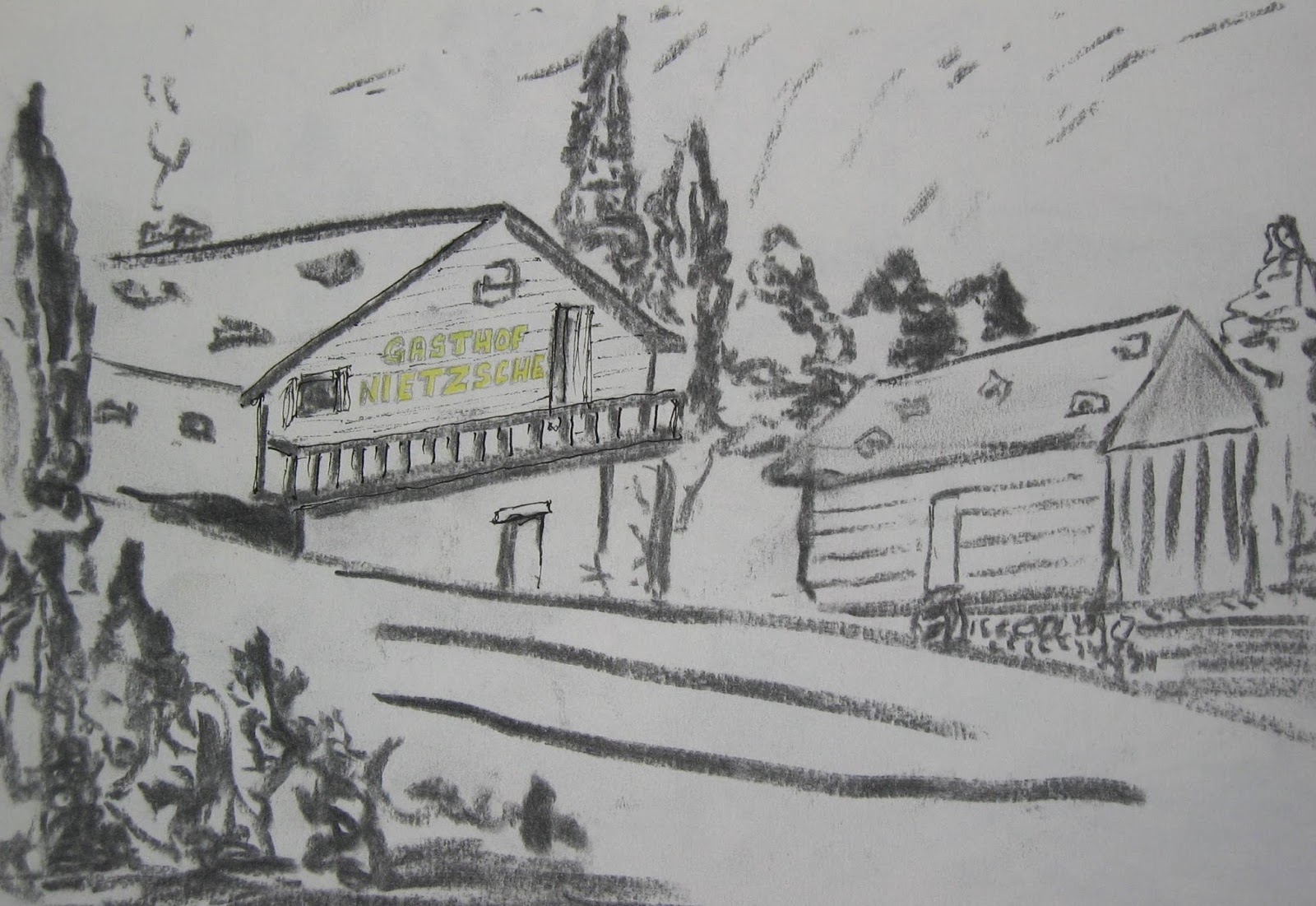
So, onwards and upwards.  Today I worked to commit to drawing the actual deconstruction works of Autumn in Switzerland itself, I have previously thought of the scene being exactly that...

A trace drawing in a minimal way helped the process for me to engineer and create a possible model. This provided me with a conceptual scene...

A Scene, just as a theatrical staged presentation, and so, what would be behind the frame? (As declared by Derrida)....

 "What is one the outside of the picture" has been a typical conversation that I've engaged with the tutors.  I thought I would take this a step further and ask what is actually behind the scene.

My imagination has been suitably stimulated to think of the real scene being replaced by a film set scene of Autumn inSwitzerland, hence something like this....

The empty cardboard boxes have some Derrida-esk type "undecideable" statements on them for the viewer to read.

I have also reversed the perspective of actuality, for artistic amusement. In this diegesis, the foreground items, imagined behind the foreground items of the aesthetic scene of Autumn in Switzerland, would actually be behind the background (i.e. scafolding) of the background mountains, which would be in reality be in the foreground... Is that clear?  I love this confounded sense of perspective and it is a mischevious deconstruction of reflection, in reflection....


Another pause and redirection based on my in intial thoughts happened, and taking the initial ideas of expanding the scene to the centre left mid-ground of the two young people and the small dog on the track painted within the original.  My draft idea from a few weeks ago was to expand this scene itself, to contemporise it, but overall, from a distance it would remain very similar to the original. However, when zoomed in, the actual story / narrative of the new painting, in a completely enlarged scale, would have a very different outcome from the rest of the existing scene.  I have called this new sub-deconstruction piece, "The Great Outdoors", which connects to the original nicely, but the viewer can decide for themselves what is actually going on.


--------------------------------------------------
On the extreme right of the painting, in the mid / foreground, the closest bank with trees has a very small addition to it.  Again, the view can decide for themselves what is happening.
  
 A lorry backing up
 And dumping 


-----------------------------

The small typically Alpine buildings to the lower centre, mid-ground of the painting are as I have articulated in a previous blog and a couple of sketch examples are as shown below.

I have decided after much consideration, not to complete these sub-plot sketches in as much full detail as perhaps I may have initially desired.  The reason being that I feel that I'm getting a little lost in the craftsmanship of completing an item, rather than putting my creative efforts into generating the new ideas themselves.  This is very much based on the reflection of the conversation with Dr T. on Wednesday when I think a remarkable sentence came forward, which I think encapsulates contemporary art practice within an academic environment.  It was ...
"[at University] ...It is all about becoming a better Artist, not about becoming a better 'Artisan'" 
Of course, Dr T. is right again.  If one was to explore the works of many successful contemporary artists of our present day, these individuals do not actually create the art objects themselves, but the idea and overall design of the objects.  Someone else then actually 'produces' the works, regardless of whether it is a painting, a sculpture or other item.  An example cited would be perhaps Damien Hirst, - (http://www.damienhirst.com) he has literally 10s or even 100s of production artisans working for him, (depending on what the piece is), with many different stages of art object production going on at any particular time.  The art practice therefore is more like a business, or factory type production workshop / or studio.  Another example Dr T. mentioned would be Jeff Coon's "Art Factory"... (See The Tateshots, - Tate Gallery videos, - http://www.tate.org.uk/context-comment/video/studio-jeff-koons ).

The concept of an Art Factory interests me.  There is structure to creating not only the 'business' but also the 'what' to produce is equally engaging.  It has been quite an eye-opener for me after the conversation we had on Wednesday, especially as Jill T. has helped me reach quite an epiphany on this concept.

Wednesday, 12 February 2014

Deconstructing the Grand Master, Part VIII - Benjamin Williams Leader

I had a further chat with Dr T today, which left me a little bit less clear as to where I was going with this project.  In reflection though, I think she has been absolutely right to challenge my thinking and to test my commitment.  Today I seem to have been rather fixated with the craftsmanship or practice of completing the painting into a perfect rendition.  I have made a few adjustments to it this morning but it is far from perfect in my view.  Maybe this is my trait of perfectionism again... Perfectionism is a curse!...

I have got a little obsessive with the painting, and therefore not generating many new ideas.  I have therefore come away to re-think my approach.

I am still keen to "cartoon-ify" some of the themes and ideas I have, but I want to leave a little bit of narrative to the viewer to make thir own decisions.   - I realise it's the "possible" links that people want to explore, (I recall Dr T mentioning that it's a little bit like a great novel, one that keeps you engaged, one that leads you into wanting more, - to explore deeper etc.

For example, one of my ideas was to allow the river to flood.  The melting of the glacier at the top left of the painting could be the cause of flooding in lower parts of Europe for instance.  I could put a "Closed for the Season" label in the Gesthof Nietzsche window, due to staff being unavailable, held up in the UK floods for example... :-)

However, I still wanted to look at the real world around where the painting was originally captured.  Further research and a bit of detective work found that the piece was done on  a "Road between Merringen and Rosen[baum/]"...  I checked the maps.

This is what I found !!!!!


Now, imagine if we were standing off to the left of the valley, near the river.....  The clue is in the topology of the middle distance hills, and the shapes to the right, and to the left.  Careful scrutiny show there is indeed a road (in fact, there are quite a few roads and tracks here), to the extreme left of the photo above.  You may also notice an absence of Norway Spruce trees too!... :-)


Tuesday, 11 February 2014

De-constructing the Grand Master Part VII, Benjamin Williams Leader

My guidance from Dr Townley last week left with me a strong set of messages, I've been pondering on these for most of the week end.  I kind of know what I need to do, for example, I need to;

  • ]Try to make more suggestive openings within the final piece that have less obvious messages to the viewer,
  • Incorporate items or objects into the "real" from thew virtual. Such as making the "Hotel or Gesthof Nietzsche" more tangible, (even though it doesn't exist), by creating a website advertising holidays there perhaps, or make a blog site for it?
  •  Vary and make suggestive links as to what might be happening or what might appear off the scene.  For example, zoom into the woods to show what might have been unseen in the original...
  • It's important to carry on with the story, allow the viewer carry on with their own story.  Dr T has cleverly challenged me, in that one of my traits is to be "very didactic", in other words, I try to teach / I make things too obvious!...  Dr T. is absolutely right.
    An example that was given to me was to explore a recent contemporary adaptation of Millet's remastered painting of Poppy Fields, which has been adapted to show a Rocket Launcher within the painting, - particularly poigniant when considering it's contemporary connection with the War in Afganistan and the major export of that country still being drugs derived from Opium farming (from poppies of course).
I have thought about this over the last few days and working out how I can connect the work I have already produced to the wider context of the image.  
  • What is going on outside the scene?
  • Is this just a stage set?... = This generated more ideas, and a quick sketch showing stage props
  • What's happening outside boundaries of the scene in Switzerland? - I committed myself to finding out where the "Leader" scene actually was, trying to find the actual road on Google Maps...
  • My thoughts on this being a Wasteland... This conjured up a memory when I was working in Germany.  - Namely, my old German friend and colleague Jurgen Nolle, who thought that the UK's "British Layland" had been a rather unfortunate choice for a name, as in german, there is a very similar word of 'Ayland', which when translated, virtually means "Wasteland".  Once this had been explained to me, I also have had a wry smile each time I have heard this phrase.  Jurgen was right!...  
  • Because of that little spark being refreshed in my mind, I thought of the Swiss Ayland, and then as a result, the link to Derrida's "Un-decideables" and such being linked to our previous project of Liminality and "In-Between-ness"... There is a good segue between the two, and I think it is very clever of Dr Townley, Christian, Bob P. and the lecturers / tutors of the university to have linked the projects in this way.
I have decided to continue with the piece however. I want to finish the painting to a standard that does leave the viewer a little confounded.  One area that I hadn't considered until the weekend was the type of trees that Leader had rendered in Autumn in Switzerland.   It appears that there are some Norway Spruce Trees in the foreground.  Whilst these could have been in the original scene, I wondered if he had painted the actual works in his studio, in which case he may have been influenced by the recent (at that time) gifts of the classic Christmas Tree shape (i.e. Norway Spruce) to Queen Victoria.... My research suggests that the actual trees would have more likely been Swiss Stone Mountain Pines, that are rather different....  So in that alone, there is a subtle correction / deconstruction.

Friday, 7 February 2014

Deconstructing the Grand-Master, (Benjamin Williams Leader) part VI

I spent most of Tuesday and Wednesday repainting the Benjamin Williams Leader image of Autumn in Switzerland.  Some really great feedback from Dr Townley helped me to crystalise my thoughts on where I was going with the "deconstruction"....  - Whilst I want to make an image as close to the original as I can, but in much brighter and vibrant colours that Williams-Leader used, I have also been playing around with the theme that the small Chalet / Ski Lodge nestling in the centre of the picture, my imagination would suggest that by now, the prperty is likely to have been replaced with a hotel.  The Glacier on the top left will have probably melted by now (global warming) and many of the trees would be affected with Acid Rain no doubt!... In fact, most of the trees will have been felled (in the 1890s the dominant tree would have been the Norway Spruce, especially in Alpine Switzerland) and replaced with faster growing, more commercially viable Northern White Cedars...


I decided to leave the representation for a day or so, in order for me to re-approach it and correct any failings.  I always find it best to walk away for a couple of days and sleep at night with the happy image bouncing around in my head, before re-approaching the painting with a renewed critical eye....

Here is where I am up to so far...

There is still a lot to do on this painting before I will be happy with it.  For example, the left and right foreground needs to be completed. In particular, the addition of a Mountain Ash to the mid-left, the addition of two contemporary children (now on mountain bikes), taking a rest, and the completion of the Hotel Nietzsche, to the centre right of the picture.  This is the item that I want to explore much further.

I chose the name of the Gesthof / Hotel to reflect the 'German' Philosopher, Friedrich Nietzsche, who would have been not only alive, but also very near, if not present, at the time this original painting was made.  I noted that Nietzsche was born in what was then the Kingdom Prussia, but denounced his citizenship of  of Prussia, whilst he was Professor of Classical Philosophy at Basel University, Switzerland.  He therefore may very well have visited this place around the time of it's reproduction in 1878 by Williams-Leader.  By this time, Nietzsche had been in Switzerland for almost 10 years and was coming to the end of his attachment to the University of Basel. He was declining into poor health, which he had suffered from many ailments most of his life, and had to resign from his post as Professor at Basel. He was however, able to provide for himself, living from the small pension that he secured from the University and the generosity of his friends.  It is known that Nietzsche often travelled to seek better, more agreeable climates to improve his health and continued his philosophical work, writing independantly until 1889. My research suggests that he spent many summers in Sils Maria near St. Moritz in Switzerland.   The reference to Nietzsche is also very much a play on the theme of Nihilism, linked with our contemporary Global Warming and nihilist consumerism.

My conversation with Dr Townley helped a great deal in prompting and helping to generate ideas. For example, we thought of putting up  a dummy website advertising Hotel Nietzsche, and various other contemporary vehicles to draw attention to it.  Dr Townley recommended that I try to make more suggestive references in the imaging, to lead the viewer into further interest, to make the scene and associated artifacts more open to the viewer's curiosity. I like this approach and I think there is much to do both as opportunities and to finish this piece.

Tuesday, 4 February 2014

Deconstructing the Grand Master, Part V (Benjamin Williams Leader)

I paused again a little today, to reflect upon the original concept by Derrida on the subject of Deconstruction in his own terms.  I also looked again at how I could be true to Derrida's challenges and methods.  The thought occurred to me that Derrida's state of Undecidables, is very similar to the state of "in-between-ness" that formed a central pillar of our Liminal project.

I had been re-considering the chosen painting, for example, I wondered about using some of the more well known Grand Masters of the late 19th centrury, in particular, William Turner and perhaps one of his seascapes. However, I decided that both the works and Turner himself will have been the subject of deconstruction, and so I settled on the journey I had already started.

My choice of Benjamin Williams Leader's "Autumn in Switzerland" seemed rather well confirmed by this little reflection, the image is capable of having both undecide-ability and liminality applied to it...

So I happily continued with a complete re-start on the painting as potentially a finished artifact, but this time, I will con-temporise the image with some animation and gentle whimsicality, more acceptable in my view to a contemporary critique.


Monday, 3 February 2014

Deconstructing the Grand Master,part IV - Benjamin Williams Leader

My focus of attention has happily explored quite a few genres and styles over the last week, but despite the wandering mind, I have settled it seems, on the work of Benjamin William Leader again.  I am still very much drawn to the painting Autumn in Switzerland....

Benjamin Williams-Leader, Autumn in Switzerland

CL, my year tutor, has suggested I could review the work of a contemporary Artist who uses the theme of the sublime as a backdrop to his paintings, often created with very unusual media.  That is, the work of Anstelm Kiefer,  (born 1945, Germany).  Information extracted as follows from http://whitecube.com/artists/anselm_kiefer/

Anselm Kiefer (born March 8, 1945) is a German painter and sculptor.  Works incorporate materials such as straw, ash, clay, lead, and shellac. The poems of Paul Celan have played a role in developing Kiefer's themes of German history and the horror of the Holocaust, as have the spiritual concepts of Kabbalah.

In his entire body of work, Kiefer argues with the past and addresses taboo and controversial issues from recent history. Themes from Nazi rule are particularly reflected in his work; for instance, the painting "Margarethe" (oil and straw on canvas) was inspired by Paul Celan's well-known poem "Todesfuge" ("Death Fugue").

His works are characterised by an unflinching willingness to confront his culture's dark past, and unrealized potential, in works that are often done on a large, confrontational scale well suited to the subjects. It is also characteristic of his work to find signatures and/or names of people of historical importance, legendary figures or places particularly pregnant with history. All of these are encoded sigils through which Kiefer seeks to process the past; this has resulted in his work being linked with a style called New Symbolism.
Il mistero delle cattedrali - Anselm Kiefer - 2010-11 - 43802
Amstell Kiefer,  Ill Mistero delle Cattedrali - 2010 /2011 No1.
Il Mistero delle Cattedrali - Anselm Kiefer - 2011 (tbc) - 43773
Anselm Kiefer, Ill Mistero delle Cattedrali 2011 No. 2

I have created a simple Acrylic sketch painting of the Benjamin Williams Leader - Autumn in Switzerland piece, after doing a number of test pencil sketches.  This has allowed me to get a deeper feeling for the original painting, and I've tried to make the beauty of the original aesthetic much more barren and drab, casualty of acid rain etc, generally emulating the current global issue of global warming and climate crisis;


My plan now is to re-paint this work, spending a little more time on accuracy and placing of the principle objects in Williams-Leader's original painting.

Friday, 31 January 2014

Deconstructing the Grand Master Part III - Walter Richard Sickert

Many exhibits in the local gallery proved to be excellent candidates for deconstruction.

© the artist - Frank Helmuth Auerbach
photo credit: Kirklees Museums and Galleries
I looked at the possibility of adapting and deconstructing an Auerbach painting, very hard to distinguish what is was, and then it became clear.  It is based on one of Frank Helmuth Auerbach's girlfriends (at the time), whom he referred to as JYM.  I have later discovered from the BBC website (Your paintings)   at http://www.bbc.co.uk/ arts/yourpaintings/artists/ frank-helmuth-auerbach ) that JYM later became his wife.  Dr Ian Massey explained to me on out Gallery visit that Auerbach's paintings have a very strong recognizable style, this is owing to the heavy application of oil or acrylic paint and then by using a scraping technique with palette knives, much of the medium is concentrated in heaps on the canvas, little of it actually being removed... This leads to a finished result that is almost as much sculpture as painting.  Some of the works are so heavy with paint that they are exhibited flat rather than hung.

The painting in Kirklees Gallery's collection is one of a number of similar studies, "JYM seated"... I wondered if this could be adapted to show an alternative subject, I was thinking of a recent mythological superhero known as "The Thing" from Marvel Comics "The Incredibles"... The Aurbach image reminded me of the block type representation, together with earth colours, which in The Thing would be represented well by Yellow Ochre / Burnt Ochre.

The following painting by Walter Richard Sickert was also considered for deconstruction;

View of Margate - W.R. Sickert, 1930. Hudds. Gallery
Sickert was seen as an extremely important and influential contemporary artist in his day, (particularly in the 1930s when this painting was completed). his views that many traditional paintings were over-sentimental encouraged an opposing response in him to create art that took it's subjects from real life, in all it's misery and darkness. W.R. Sickert was a member of the Camden Town Group of artists, and his work provided much of the foundation of their genre.

Sickert spent time in Paris, I noted that he was influencial to another contemporary peer of the 1920s who was also a theatre scene painter, - one Vuillard. The french Impressionists paintings, being produced both at the time and prior to Sickert's visit, provided a strong influence to other contemporary British artists of that era.  It was believed for some time (as according to Alan Bennett) that Sickert called his group "The Camden Town Group" after the Camden Town murder of 1907, an event were a prostitute was murdered after her partner found out she was cheating on him.  He cut her throat whilst she was asleep, and then escaped the following morning.  The story was heavily reported and sensationalized in the press, that being similar to Jack the Ripper in some ways, although not linked.  Sickert was so enthralled by the story that he painted a series of four paintings depicting the murder scene and the murdered nude subject.
File:Sickert.jpg
Walter Sickert, 1908 - The Camden Town Murder, originally titled, What Shall We Do for the Rent?

(Image from http://www.guardian.co.uk/artanddesign/2001/dec/08/art.artsfeatures ) .  In this painting, Sickert was sticking to his view that nudes did not have to be portrayed in perfect poses and supporting his claim that paintings also had to deal with real life events.

I thought long and hard about representing a revised view of Walter Sickert's image of Ramsgate in 1930, shown above and how I could revise it, however I had also found a similar painting of Whitby Harbour, which was painted by Robert Henry Lee, in 1951.


I found this too contemporary and similar to Sickert's View of Ramsgate and abandoned the deconstruction.


Before leaving Sickert and after having been drawn in to the work of Sickert, I found another wonderfully expressive painting of an early nude scene, full of symbolism...

Walter Sickert (1860-1942)  The Rose Shoe, c. 1902-1905 Oil on canvas - Private collection,
 The Art Tribune. (See http://www.thearttribune.com/Walter-Sickert-The-Camden-Town.html)

 The symbolism contained in lots of works of art, especially prior to 1850s, carry many meanings that the casual observer may easily overlook.  What appear to be simple objects, such as a solitary slipper, a lap dog or a man handing a woman a dead bird for example, carry huge secret or hidden messages especially in the European / Dutch style. The examples given in this paragraph all suggest much more than the subtlety of the aesthetic.  A slipper on the floor suggests  that a woman in the painting is "available".  A lap dog in the picture is a symbol of the woman's fidelity. And a dead bird being handed to a woman is extremely suggestive, as the Dutch for bird is vogel, which also happens to be the same derivative word translation of  "phallus" .  Indeed, a old slang phrase for sex was "to bird" a woman.  (Nowadays, "giving the bird" is an obscene gesture of raising the middle finger, - now you can link the two more clearly!...)
The inclusion of such cryptic clues puts an entirely different connotation on the art work being viewed....

Wednesday, 22 January 2014

Deconstructing The Grand Master, part II

Having made a number of sketch copies of Leader's painting, I paused to reflect on my choice of subject.  Together with a colleague that I'm working with, we revisited the local art gallery that gave me the inspiration to choose Leader's work.

During the previous visit, as a guided group we de-constructed a number of other exhibits and proposed contemporary modifications to them. One exhibit in particular, perhaps one of the more famous that was being displayed, was on temporary loan from York Gallery.  The painting in question was created by Edward Matthew Ward, and celebrates another true english "great master",  that being William Hogarth.

Edward Matthew Ward RA (14 July 1816 – 15 January 1879) was an English Victorian narrative painter - perhaps best known for the wall coverings that formed part of the commission of the fresco on the walls joining the House of Commons and the House of Lords, which record various episodes in British history, particularly of military notes of interest, from a time span between the English Civil War to the Revolution of 1688, (which was the revolution that removed King James II of England (James VII of Scotland and James II of Ireland)). The Revolution of 1688 is also known as the Glorious Revolution.


The landing of Charles II at Dover 1660 By Edward Matthew Ward, 1864.


Copyright acknowledged, downloaded for non-commercial research and private study purposes only - http://www.parliament.uk/site-information/copyright/terms-for-images-featured-on-art-in-parliament/)

(...As an interesting side-note, the revolution of 1688, which was orchestrated by a union of English Parliamentarians together with the backing of the Dutch William III of Orange-Nassau (also known as William of Orange), set in motion one of the longest conflicts in english / british history. The Dutch King William, having successfully invaded England with a Dutch fleet and his army led to his ascension of the English throne,  as "William III of England" which was established jointly with his wife Mary II of England.   As a result of the subsequent passage of the Bill of Rights, it stamped out once and for all any possibility of a Catholic monarchy, and ended moves towards absolute monarchy in the British kingdoms by circumscribing the monarch's powers. These sovereign powers were to become greatly restricted;  A King or Queen of England could no longer suspend laws, levy taxes, make royal appointments, or maintain a standing army during peacetime without Parliament's permission.  To this day the Army is known as the "British Army" not the "Royal Army" as it is, in some sense, Parliament's Army and not that of the Queen's.  Furthermore, "The Williamite war" in Ireland can be seen as the source of later conflict, including 'The Troubles' re-ignighted many times through indescrimitate violence and acts of terrorism of recent times. The Williamite victory in Ireland is still commemorated by the Orange Order for preserving British and Protestant dominance in the country, and is still a Contemporary source of hatred, conflict and disharmony in 2014).

Anyway, back to the Edward Matthew Ward...  Ward's murals of Britain's past conflicts can be found at the Palace of Westminster in London's central borough.  (See Terms for images featured on Art in Parliament, at http://www.parliament.uk/site-information/copyright/terms-for-images-featured-on-art-in-parliament/)

Ward was a prolific artist, and while a student at the Royal Academy, he became a member of a group known as The Clique, a group of painters led by Richard Dadd. (The group, also included William Powell Frith, Augustus Egg, Henry O'Neil and others). These artists were generally followers of Hogarth and Wilkie, and were determined patriots with a style that portrayed British nationalism in particular. I had come across Richard Dadd once before, whilst researching the history of mental health treatment in the UK.  Of morbid interest, Dadd spent 20 years in London's Bethleham Hospital (also known as "Bedlam"), after he fell in while touring Europe (probably through mental exhaustion which triggered an underlying Schizophrenic condition). He came home to be nursed in his family home in Cobham, Kent, then became convinced his father was a re-incarnation of the Devil and subsequently killed him by stabbing him to death. He fled to the continent, tried to stab another tourist and was captured by french police and returned to London.  He confessed to killing his father and was certified as criminally in sane.  This saved him from being hanged for murder. After his 20 year spell in Bedlam, he later became one of the first inmates of the notorious Broadmoor Hospital in Surrey, which today holds some of our most disturbed patients and criminals.  He continued to paint for the rest of his life.

Back to De-constructing Ward... The subject and title of Ward's painting we de-constructed together with our University Tutors is "Hogarth's Studio in 1739"  created in 1863 - some 124 years prior to the date that Ward painted this imagined scene.  How Ward recreated this image is very interesting.  Arguably, I felt this 150 year old painting, depicting life some 275 years ago, could be inverted in it's intended meaning and described as a classic piece of propaganda. It glorifies a rich patron of Hogarth, the businessman and philanthropist Captain Thomas Corum, together with Mrs Corum who were benefactors of the Foundling Hospital (later to be known as the Thomas Corum Foundation for Children, a charity which still exists to this day).  See The UK Charity Website of "Corum"

Our very own 21st Century contemporary artist, Grayson Perry, RA, has said of the Foundling Museum, (set up to celebrate the care in Captain Corum and his wife's legacy);
 ...“A seaman, a composer and a painter, and the moving story of the charity they started 270 years ago. It is a recipe of art and care, which still looks after kids today. Coram, Handel, Hogarth, what’s not to love?” - Grayson Perry RA, artist and 2010 Hogarth Fellow
Hogarth's studio in 1739 (By Edward Matthew Ward, 1863)

This imaginary scene is set in William Hogarth’s studio in 1739. Hogarth has completed a portrait of Captain Thomas Coram, the benefactor of the Foundling Hospital. A group of children, in their best dress, are visiting the studio to see the picture; Hogarth and Coram hide behind the canvas. To the left, a black servant boy holds a tray of refreshments and Mrs Hogarth slices fruit cake.

There are some discrepancies in the legitimacy of the date in subject image and name of Wards painting. My initial research into Thomas Corum's life suggests that the Foundling Hospital was actually established in 1741, some 2 years after the imagined scene in Ward's depiction of Hogarth's studio.  However, further records (see details of The Old Corum Association established in 1947, web-page at http://www.oca1947.co.uk/index2.htm) suggest that Captain Corum obtained a Royal Charter to build a school in 1739, the year of Ward's imagined scene.  The first children were admitted to the Foundling Hospital on Lady Day, 25th March 1741, so the children depicted in Ward's painting could not have been part of the Foundling Hospital...

In a contemporary sense, the issue of child abuse has recently been highly publicised.  A number of historic children's institutions traditionally thought of as safe places for improving child welfare, have been exposed as sites harbouring deviant administrators, care-workers and/or patrons.  In no way am I suggesting that there has been any abuse related to the paintings or subjects of the paintings by Ward.

 However, with a view in a contemporary deconstruction, the philanthropist and "children's friend" that I once considered (especially during my own child-hood) to be of extreme trust, was one Jimmy Savile.
(Sir James Wilson Vincent "Jimmy" Savile, OBE, KCSG (31 October 1926 – 29 October 2011) was an English DJ, television presenter, media personality and charity fundraiser. He hosted the BBC television show Jim'll Fix It, was the first and last presenter of the long-running BBC music chart show Top of the Pops, and raised an estimated £40 million for charities.)  After his death, hundreds of allegations of child sex abuse and rape finally emerged, leading the police to believe that Savile was a predatory sex offender, and may have been one of Britain's most prolific sexual offenders).

Whilst the image of Jimmy Savile could be substituted into a painting similar to the image of Captain Thomas Corum, and produced as a grotesque and conflicting subject matter, I am too cautious to do so, to address public sensitivities in an ongoing legal battle from victims goes against my own moral sensibilities.

Nevertheless, such  a graphic contemporary deconstruction can be easily re-imagined by a reader of this blog.

My reflections of the above thoughts being put to one side, I continued with my search for subject matter to deconstruct.

Monday, 20 January 2014

Return to Uni - New term project = Deconstruction.

Today marks the return to University after the Christmas and New Year break...  Whilst I was away, I used my time productively with regards to research and also practice (three sketches produced, one in Acrylic (my first attempt at using this medium), of an imagined landscape inspired by spending a week in Northumberland just after Christmas this year,

 a pencil landscape sketch (again from imagination, based on last August's holiday in California) and a pencil, charcoal and acrylic still life sketch of a vase of flowers / Lilies, Chrysanthemums and Bear Grass).


My previous reading and introduction to Derrida seems to have been well timed.  This semester's first project is "Deconstructing The Grand Masters"... In essence, our task is to look at any artwork prior to our birth, and establish within it, contemporary view points.  These can be CURRENT cultural, artistic, political, social or other domains, issues or ideas which are specifically contemporary or current.

The process of research remastering and deconstruction needs to be documented through Studio Work, note books, drawing notes etc...

  *** A CHRONOLOGICAL presentation or animation must be produced for the assessment at end of term. ***

This looks like a project that I can get my teeth into! I've been inspired by a number of examples given to us, including;

Jeremy Deller's "Battle of Orgreave" 1999

Myriam Dien's "Newspaper cut like embroidered lace" and other works.

This project should help me to understand the scales of current art works, and visualise both physical sizes of work, but also just as importantly, the value or importance placed on particular issues in contemporary culture.

It may be easy to become too littoral in some sense as a "Grand Master" is not necessarily a Renaissance artist, as it could of course include any artist up to 1963 (My birth year).  So that opened up some possibilities for exploring the likes of Lowery, Aurebach or Stanley, or Siekhert and other 20th century artists.

By considering the political or geo-political space or situation that these artists were placed, there own work has specific resonance.  This can then be explored, played with, and given the Derrida treatment of finding contemporary oppositions to their status and conditions.   Finding those current positions can then be repositioned within a contemporary up to date context.

A key word in Artistic deconstructions seems to be "Appropriation."

To me, and perhaps a naive initial thought would be that appropriation means theft.  However, if I recall some law training from a previous life, the definition of theft is "By dishonestly appropriating property belonging to another with the intent to permanently deprive them of it"...   So in  this case, as there is no intent to permanently deprive the originating artist of his works (we are just using their scene as a framework for deconstruction) then I feel we can all have a clear moral conscience.

The afternoon's lecture gave us an opportunity to visit the local Huddersfield Gallery, and some assisted  critique from our lecturers of the exhibited works.

I chose to work with a painting that was of immediate impact to me, particularly as I had visualised and painted a simple acrylic sketch of something very similar during my Christmas Vacation...  If you look at the bottom right hand corner of Benjamin Williams Leader's painting of "Autumn in Switzerland" (1889) there is similarity to the imaginary aesthetic I created, of a conifer next to a river with two boulders and additional conifers behind it to the right... I know this is a tenuous link, but it made me look further into his works and allowed me to reflect on the aesthetics.

Image in the public domain, - Downloaded from http://www.bbc.co.uk/arts/yourpaintings/paintings/autumn-in-switzerland-21838 
The painting is a stunning Oil on canvas, measuring about 125 x 181 cm (estimated) which covers a wall in the Huddersfield Gallery on the upper floor.  The detail in it is superb, which resonates with my inner natural desire to record detail.

Many parts of the painting lend themselves to be brought into the 21st century.  The first obvious one perhaps being the track at the foreground of the works, is likely to be metalised (or Tar-McAdam-ed). There are two children and a dog in the centre left mid-ground.  I would expect these children to have mountain bikes and crash-helmets on these days, perhaps using an Apple iPhone to record the valley's natural beauty.  There would likely be more waste paper / rubbish / old drinks cans etc scattered on the track and in the river areas.  There is a backlog of detritus to the right of the river in the mid-ground, this could have additional rubbish added to it.   I suspect the conifers are likely to have suffered from Acid Rain on the right bank.  Further back in the painting, there is a beautiful classical Alpine Lodge and outbuildings to the right centre;  This could well be a hotel by now and be accompanied by either a replacement parent hotel building or additional dwellings.   The glacier at the far top left is likely to be affected by  global warming which could well have raised the river levels to a greater torrent.  A cable car would also likely feature in the painting, perhaps to the centre far background with a corresponding commercial ski slope.....  There are plenty of opportunities for some mischievous deconstructions to be given to this painting.


Monday, 13 January 2014

Introduction to Derrida & Deconstruction


Our first project for the new semester will be themed upon deconstruction.  The opportunity to look at this field, prior to starting the semester presented itself by chance to some degree, so I started to prepare early.

Having searched the University's Library resources for Art and Deconstruction, the following titles were suggested;

Art Since 1900;  Modernity, Anti-Modernity and Post-odernism.  By H Foster & R. Krous (2004) Pub. Thames and Holden.  (Lib Reference 709.04 ART.    - This is a huge book, has loads of information, but is rec

Talking Art - Interviews with Artists since 1976,  Lib Reference 709.22 TAL...  Another huge book... Rather boring too, didn't seem to have the inspiring information I was hoping for...

Art;  Key Contemporary Thinkers (2007) Library reference 701.COS

Deconstruction; A Students Guide.  Library Ref; 724.91 DEC  This is an Architectural Book, published by the Architects (???) Academy....

and then finally, I chose to look at the philosopher himself, Derrida.  Understanding Derrida, Lib Ref 194.DER

I found the Icon Books, Introducing Derrida most useful.  He seems to follow a theme that at first glance, appears to be 'capricious contrarianism'!  It seems that anything put forward to him as an idea is cleaved in to two parts.  (This is usual for Western Philosophy, as it fits with the discourse based on the definition of opposites, which are then discussed with distinct determinist views, based on evidence, either 'for' or 'against' a proposition).  However, in Derrida's approach of Deconstruction, the two opposites are manipulated to find potential mid-ground, (which in some of the examples I have seen, could be described as tenuous or even fatuous links). This middle ground, or 'in-between-ness' he describes as the "Deferance" which is populated with "undecide-ables".   If I was to apply his own approach to his own working practices, I could suggest that "Differance" sounds too much like Differ being added to the word "France", from which he is an (Algerian born) citizen.   Maybe he wants to 'plug' the French?  Set France as a leader in philosophy perhaps?

Using his own literary logic again, 'Di' from the greek means two, as in two parts, or to cleave, as in dissect, Divide, etc (the same as 'sunder' in old english)... Added to the Philosopher Foucault = Di-Foucault

Difficile = Difficult  ..... Well, (Example>) 'I always thought that the French could be difficult at times' ( this has two meanings, isthat the french language, or the french people?)....

Coming back to the word 'plug' again, this also has two (or more) meanings... As in 'to plug a publication or idea' means to promote the same... Or it can also mean to stop something or insert something into a socket (or mouth)... So, the above is all a little example of how pretty much anything can be misconstrued, or deconstructed....

Derrida
Derision            (......To ridicule)
Division            (...... To split in two)

Diversion          (......To change course)
.............  Where to now?